
A1C Calculator

Use this free A1C calculator to convert between A1C percentage and estimated average glucose (eAG) in mg/dL or mmol/L. Enter your hemoglobin A1C value to see your average blood glucose level, or enter an eAG reading to calculate your estimated A1C. Results include a color-coded risk badge showing whether your level falls in the Normal, Prediabetes, or Diabetes range.

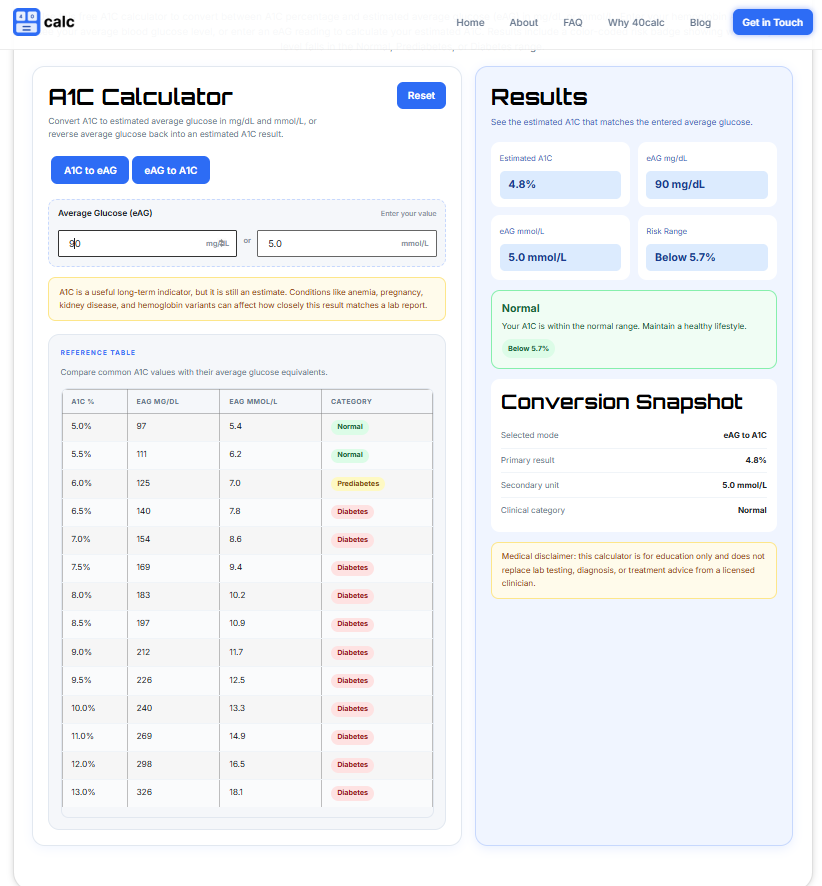
A1C Calculator

Convert A1C to estimated average glucose in mg/dL and mmol/L, or reverse average glucose back into an estimated A1C result.

A1C is a useful long-term indicator, but it is still an estimate. Conditions like anemia, pregnancy, kidney disease, and hemoglobin variants can affect how closely this result matches a lab report.

REFERENCE TABLE

Compare common A1C values with their average glucose equivalents.

A1C % eAG mg/dL eAG mmol/L Category
5.0%975.4Normal
5.5%1116.2Normal
6.0%1257.0Prediabetes
6.5%1407.8Diabetes
7.0%1548.6Diabetes
7.5%1699.4Diabetes
8.0%18310.2Diabetes
8.5%19710.9Diabetes
9.0%21211.7Diabetes
9.5%22612.5Diabetes
10.0%24013.3Diabetes
11.0%26914.9Diabetes
12.0%29816.5Diabetes
13.0%32618.1Diabetes

Results

See the estimated average glucose that matches the entered A1C.

Estimated A1C
7.0%
eAG mg/dL
154
eAG mmol/L
8.6
Risk Range
6.5% and above

Diabetes

Discuss this result with your healthcare provider for proper guidance.

6.5% and above

Conversion Snapshot

Selected mode
A1C to eAG
Primary result
154 mg/dL
Secondary unit
8.6 mmol/L
Clinical category
Diabetes
Medical disclaimer: this calculator is for education only and does not replace lab testing, diagnosis, or treatment advice from a licensed clinician.

Disclaimer

This calculator is for educational use only. It does not replace lab testing, diagnosis, or treatment advice from a licensed healthcare professional. If you have symptoms, unexpected results, or an existing diabetes diagnosis, use this tool as a reference and discuss the result with your clinician.

Quick Facts & AI Summary

  • Convert A1C percentage to estimated average glucose (eAG) in mg/dL or mmol/L, and vice versa.
  • Risk thresholds: Normal (below 5.7%), Prediabetes (5.7% to 6.4%), and Diabetes (6.5% and above).
  • Calculations follow the standard ADAG formula: eAG (mg/dL) = (28.7 x A1C) – 46.7.

About A1C Calculator

A1C Calculator

How to Use the A1C Calculator Based on Average Glucose

This A1C calculator based on average glucose works in two directions — enter your A1C percentage to get your estimated average glucose, or enter your average glucose reading to get your estimated A1C value.

Step 1 — Choose your conversion direction Select A1C to eAG if you want to convert an A1C percentage into an average glucose value. Select eAG to A1C if you already know your average blood glucose and want to find the matching A1C percentage.

Step 2 — Enter your value Type your A1C percentage into the A1C field, or enter your average glucose in either mg/dL or mmol/L. The mg/dL to A1C calculator automatically syncs both unit fields so you only need to fill in one.

Step 3 — Read your result Your converted value appears instantly in the Results panel alongside your clinical category — Normal, Prediabetes, or Diabetes — based on American Diabetes Association guidelines.

Step 4 — Use the result as context only This calculator is an estimation tool. Always confirm any A1C result with a certified laboratory blood test and discuss the outcome with your healthcare provider before making any health decisions.


A1C Calculator Formula

The A1C calculator formula used on this page is derived from the ADAG (A1C-Derived Average Glucose) study, published in Diabetes Care by Nathan et al. (2008). This is the same formula used by the American Diabetes Association and most clinical diabetes management tools.

A1C to eAG (mg/dL) eAG = (28.7 × A1C) − 46.7

A1C to eAG (mmol/L) eAG = (1.59 × A1C) − 2.59

eAG (mg/dL) to A1C A1C = (eAG + 46.7) ÷ 28.7

eAG (mmol/L) to A1C A1C = (eAG + 2.59) ÷ 1.59

mg/dL to mmol/L conversion mmol/L = mg/dL ÷ 18.01559

All four conversions are available in the calculator above. The mg/dL to A1C calculator direction is particularly useful for people who monitor blood sugar with a glucometer and want to estimate their expected A1C before a lab appointment.


Key Factors That Affect Your A1C Result

A1C reflects a 2 to 3 month average Unlike a fasting glucose test that measures your blood sugar at a single point in time, A1C measures the percentage of hemoglobin coated with glucose over the past 2 to 3 months. This makes it one of the most reliable long-term indicators of blood sugar control.

The result is an estimate, not a diagnosis The A1C calculator based on average glucose produces a statistical estimate based on population data. Individual results can vary depending on red blood cell lifespan, hydration levels, and metabolic differences between people.

Medical conditions can affect accuracy Conditions including sickle cell disease, iron deficiency anemia, kidney disease, liver disease, and recent blood transfusions can cause A1C readings to appear higher or lower than your true average glucose. If you have any of these conditions, your doctor may use alternative tests such as fructosamine or continuous glucose monitoring instead.

Lab timing and trend matter more than a single number A single A1C value tells only part of the story. Tracking A1C results over multiple tests, alongside fasting glucose and post-meal readings, gives a far more complete picture of blood sugar management.


Typical A1C Ranges

Category A1C Level eAG mg/dL eAG mmol/L
Normal Below 5.7% Below 117 Below 6.5
Prediabetes 5.7% – 6.4% 117 – 137 6.5 – 7.6
Diabetes 6.5% and above 140 and above 7.8 and above
Well-managed Diabetes Below 7.0% Below 154 Below 8.6

Ranges are based on American Diabetes Association guidelines for non-pregnant adults. Target ranges for children, elderly individuals, and pregnant women may differ — always confirm targets with your healthcare provider.


References

View all Calculators

Frequently Asked Questions

Everything you need to know about A1C Calculator

What does A1C measure?
A1C measures the percentage of hemoglobin in your blood that has glucose attached to it. Because red blood cells live for about 2 to 3 months, A1C reflects your average blood sugar level over that entire period — not just on the day of the test.
An A1C below 5.7% is considered normal. Between 5.7% and 6.4% indicates prediabetes. A result of 6.5% or higher on two separate tests is generally used to diagnose diabetes, according to the American Diabetes Association.
The calculator uses the ADAG formula developed from a clinical study that matched A1C values to continuous glucose monitoring data across a large group of participants. The formula is: eAG (mg/dL) = (28.7 × A1C) − 46.7.
The values represent the same glucose level expressed in different units. mg/dL is used primarily in the United States while mmol/L is used in most other countries. To convert: 1 mmol/L = 18 mg/dL.
Do not use this calculator result as a self-diagnosis. If your A1C reading from a lab test is above 5.7%, speak with your doctor as soon as possible. Prediabetes and early-stage diabetes are highly manageable with lifestyle changes and, when necessary, medication.